
Responsibility: From Doing Tasks to Owning Outcomes
Moving students from passive obedience to active ownership—the engine room of a reliable classroom.

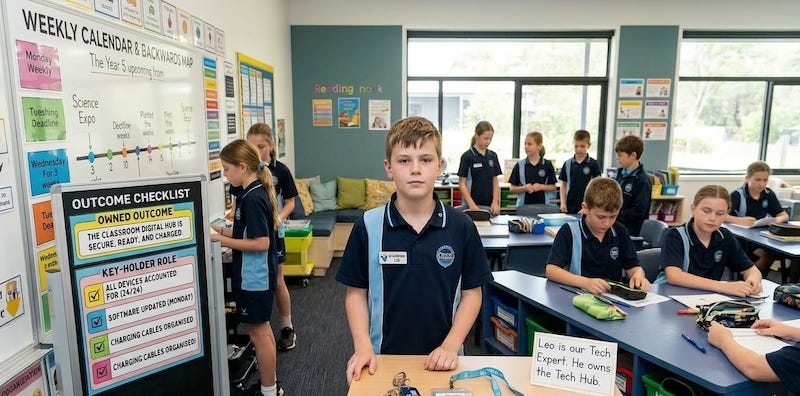
It’s easy to mistake responsibility for obedience.
We think a responsible student is simply one who does what they are told, when they are told to do it.
But in the world of leadership, responsibility is something much deeper.
It’s the engine room of reliability—the internal drive that says, “I’ve got this, and I’ll see it through.”
So much responsibility rests with you until you shift
As a principal or teacher, you know that the weight of the school or classroom often rests on your shoulders.
The goal of teaching responsibility isn’t to give students more chores; it’s to give them more “ownership.”
When you shift from giving commands to delegating real authority, you aren’t just lightening your own load—you’re helping students build the self-governance they need for a successful life.
There are many ways you can harness your students’ sense of responsibility without adding another layer of management to your afternoon.
Here are five simple ways to get started.
1. The Outcome over Instructions Shift
When you give a student a list of ten steps, they tend to concentrate on the steps.
But when you give them a desired outcome, they focus on the result.
Instead of saying, “Line up the bags and pick up the papers,” try saying, “I’m leaving the bag area in your hands—I’d like it to look ready for a tour group in five minutes.”
This gives them the freedom to decide how to get there, which is where true responsibility is born.
2. The Key-Holder Roles
Identify the small but vital systems that keep your classroom running and hand over the “keys.”
Whether it’s managing the digital devices, looking after the class library, or being the “Tech Expert” for the interactive whiteboard, give these roles a title and full autonomy.
When a student knows that a specific part of the classroom literally won’t function without their input, their level of care naturally rises.
3. The Mistake-Proof Debrief
Responsibility isn’t just about things going right; it’s about what we do when things go wrong.
If a student misses a deadline or forgets a task, avoid the lecture.
Instead, ask a leadership question: “What system could you put in place so this doesn’t happen next time?”
This shifts them away from feeling guilty and toward taking responsibility for the solution.
This is leadership development in ACTION.
4. Peer-to-Peer Accountability
In a smooth-functioning team, the leader isn’t the only one checking the work.
Share the responsibility around. Create Accountability Pairs for classroom tasks.
If one student is responsible for the resource cupboard, another student is their checker.
This builds the habit of holding each other to a standard, and it teaches them that their individual responsibility affects the whole group’s success.
5. The Legacy Handover
At the end of a term or a specific project, have your responsible leaders train their successors.
Have them explain the tricks of the trade and the common pitfalls to the next student taking on the role.
This reinforces their own mastery and treats their responsibility as something valuable to pass on to the next generation.
Why it matters
Responsibility is the foundation of trust.
When you give a student the chance to own an outcome, you’re telling them that you believe in their capability.
You’re building the quiet, inner strength that comes from being someone others can count on.
By fostering these habits in your classroom, you are helping students move from being passive participants to being active, responsible citizens of their own world.
2026 Intake Closing Soon: Final 3 Weeks

To ensure I can provide the best support to our partner schools for the remainder of the year, the Young Leaders Program intake will officially close at the end of Term 1.
If you want to embed the Five Building Blocks—Organisation, Responsibility, Teamwork, EQ, and Presentation Skills—into your school culture this year, now is the time to secure your access.
Choose the path that fits your school:
Starter Pack: The foundation for all Year 5 students.
Premium Pack: A consistent leadership language for Years 5 & 6.
Premium Plus: The full suite for Years 5 & 6, plus elite training for your elected student leaders.
Responsibility in students goes beyond obedience; it’s about fostering ownership and self-governance. Shifting from giving commands to delegating real authority helps students develop the internal drive needed for success. Focus on outcomes rather than instructions, allowing students the freedom to decide how to reach a goal. Assign key roles with full autonomy to instill care and accountability, and when mistakes happen, encourage solutions by asking how they can prevent it next time, rather than placing blame. Peer-to-peer accountability helps students learn that their actions impact the group’s success, and by having responsible students train their successors, you reinforce the value of their roles. This approach helps students grow into active, responsible citizens who are trusted and dependable.